Rwanda Orders Primary Leaving Exam Re-Sit After Cheating Confirmed
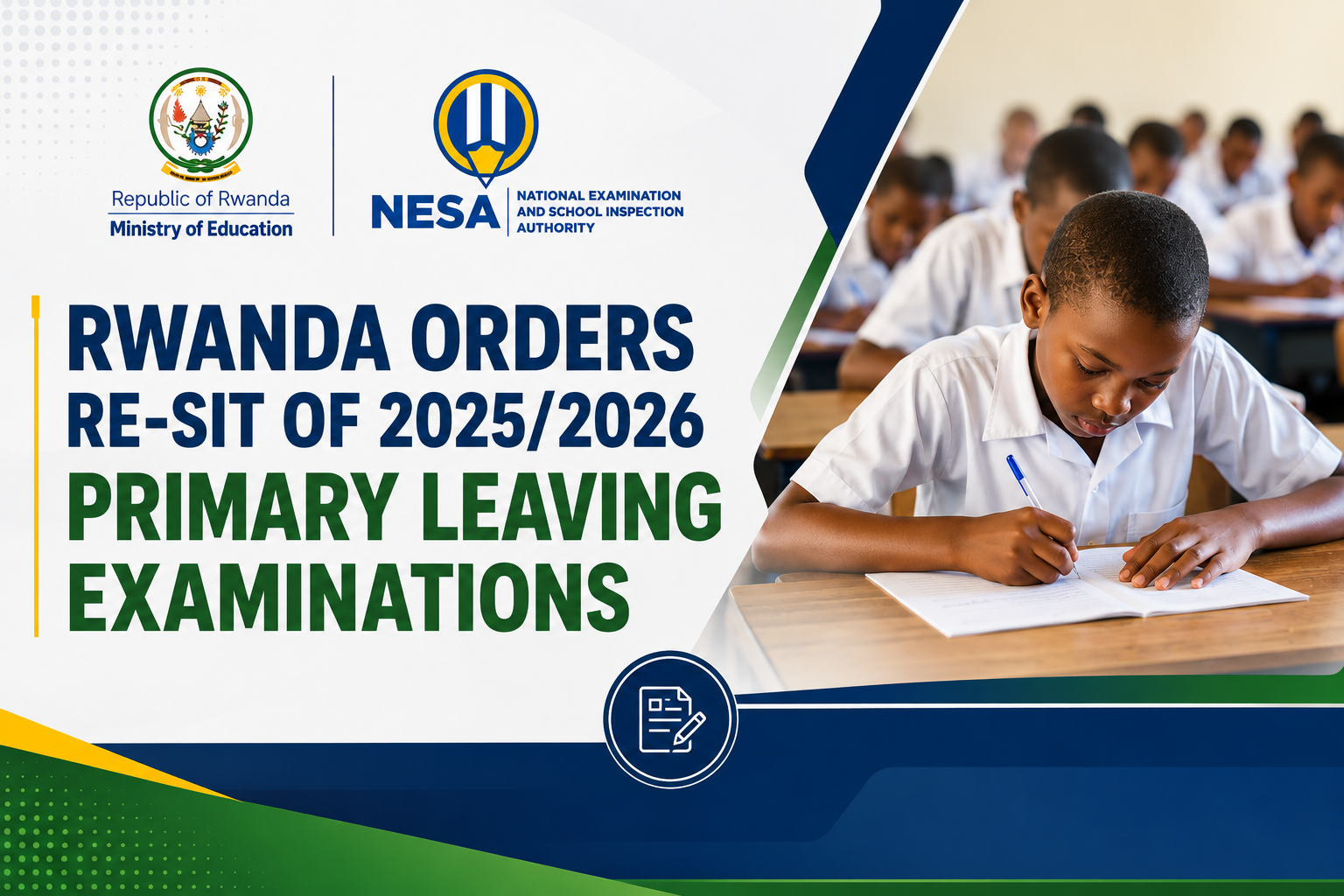
Rwanda Orders Re-Sit of 2025/2026 Primary Leaving Examinations Following Confirmed Examination Malpractice Kigali, 30 August 2026 The Ministry of Ed...
Rwanda Orders Re-Sit of 2025/2026 Primary Leaving Examinations Following Confirmed Examination Malpractice
Kigali, 30 August 2026
The Ministry of Education has announced that candidates affected by confirmed cases of cheating in the 2025/2026 national primary leaving examinations will sit the papers again, following an investigation that established malpractice on a broad scale across the country.
According to the Ministry's statement issued to the press on 30 August 2026, the investigation into cheating and the facilitation of cheating found that irregularities occurred in a generalised manner in 254 examination rooms. A total of 7,188 candidates sat their examinations in those rooms.
What the investigation established
Under normal circumstances, a candidate found to have engaged in examination malpractice has their results nullified. The Ministry, however, noted an important distinction in this case. The investigation indicated that some of the cheating was organised or facilitated by adults who had been entrusted with the responsibility of administering and invigilating the examinations.
That finding shifts a significant portion of responsibility away from the candidates themselves. Learners at the end of primary school are children, and where the misconduct was arranged by the very people appointed to safeguard the integrity of the process, penalising the candidates alone would be difficult to justify.
The decision to allow a re-sit
Citing the need to protect learners and safeguard their future, the Ministry decided to grant the affected candidates the opportunity to sit the national primary leaving examinations again.
The re-sit will take place from 2 September to 4 September 2026.
The National Examination and School Inspection Authority (NESA) is expected to publish the examination timetable and any additional guidance on 31 August 2026. The Ministry has stated that it will work closely with NESA, candidates, parents, schools and local administrative structures to ensure the exercise is conducted properly.
Given the short window between the announcement and the examination dates, schools and parents will need to move quickly to confirm which candidates are affected, where they are expected to report, and at what time. Families are advised to rely on official communication from NESA and from their schools rather than on unverified information circulating on social media.
Accountability and the integrity of national examinations
The Ministry was firm on the question of examination integrity. It stated that the credibility of national examinations cannot be compromised, and that measures to strengthen the preparation, protection and monitoring of examinations will be tightened.
The statement further indicated that anyone found to have organised, assisted in, taken part in, or knowingly observed the cheating and the facilitation of cheating will face legal consequences.
The inclusion of those who merely observed the misconduct without acting on it is notable. It signals an expectation that examination officials, invigilators, school leaders and anyone else present during the examination carry a positive duty to report irregularities, not simply to avoid participating in them.
Why this matters beyond the affected candidates
National examinations at the end of primary school serve a specific function in Rwanda's education system. They determine placement into lower secondary education and, in doing so, they shape the trajectory of a child's schooling. When results cannot be trusted, three things happen at once.
First, the learners who prepared honestly are disadvantaged relative to those who did not. Second, placement decisions become detached from actual learning outcomes, which distorts planning at school and district level. Third, and most damaging over time, public confidence in the certificate itself begins to erode. A qualification is only as valuable as the trust attached to it.
The scale reported here, 254 examination rooms and 7,188 candidates, makes this more than an isolated disciplinary matter. It points to weaknesses in supervision and control at the point of delivery, which is where examination systems are most vulnerable.
The systemic questions that follow
The Ministry has committed to strengthening examination preparation, protection and monitoring. Several practical areas will likely come under review in the period ahead:
Selection and rotation of invigilators. Where invigilators are drawn from, how they are vetted, and whether they are deployed away from schools they are connected to.
Chain of custody for examination materials. How papers are printed, stored, transported and opened, and how each handover is documented and witnessed.
Independent monitoring at examination centres. Whether external observers are present in sufficient numbers, and whether they have the authority to halt an examination when irregularities appear.
Reporting channels. Whether candidates, parents and staff have a confidential and accessible route to report malpractice without fear of retaliation.
Detection after the fact. Whether statistical analysis of answer patterns and score distributions is applied routinely to flag suspicious centres before results are released.
What candidates and parents should do now.
Affected candidates should report to the centre indicated by their school on the dates announced. Parents should confirm arrangements directly with school administrators and follow NESA's published timetable once it is released on 31 August.
For candidates, the practical advice is straightforward. The syllabus has not changed, and the preparation done for the original sitting remains valid. The immediate priority is rest, calm revision of key areas, and arriving at the examination centre on time with the required documentation.
For schools, the priority is clear communication. Every affected family should know, before 2 September, exactly what is expected of their child.
The Ministry's decision protects a group of learners who, in many cases, were placed in a compromised situation by adults. Whether it also restores confidence in the examination system will depend on what follows the re-sit: the accountability measures actually applied, and the controls put in place before the next examination cycle.
Source: Ministry of Education, Republic of Rwanda, press statement dated 30 August 2026.
Log in to join the discussion.